
What Are Police Batons Made Of?
Police batons are made from one of four materials: wood, rigid polycarbonate or ABS plastic, aluminum or steel, or rubber. Departments and security programs choose between them based on weight, impact strength, cost, and how the baton needs to be carried day to day.
Police Baton Materials
Wood
Wood is the traditional material for straight batons and nightsticks. It remains standard issue for many departments and training programs. Ash, maple, hickory, and oak are the most common species. A wood baton flexes slightly on impact rather than shattering, which is part of why it has stayed in use for so long.
Polycarbonate and ABS Plastic
Rigid plastic batons are common in side handle and expandable riot batons. They are lighter than wood or metal, resist splintering, and mold consistently across large runs, which matters for agencies outfitting a full unit at once.
Aluminum and Steel
Metal is mostly used for expandable telescopic batons rather than fixed length ones. These collapse down to a compact size for daily concealed carry, which is a major reason metal expandable batons have become common for patrol officers. However, they add weight compared to a similarly sized wood baton.
Rubber
Rubber batons deliver a softer impact and show up mainly in training equipment or specific riot control applications. They are the least common of the four material options, since most programs prioritize impact strength over cushioning.
Why Wood Remains a Standard Choice
Wood keeps its place in training, ceremonial, and institutional use. It balances weight, durability, and cost, and it machines easily to a specific length, diameter, or grip profile. This makes it a great option for buyers that need a batch built to an exact spec rather than an off the shelf size.
The rest of this guide covers what matters when specifying a wood baton.
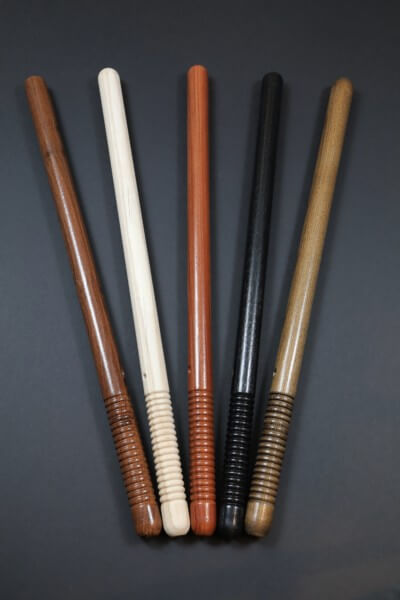
Wood Species for Police Batons
Ash and maple are two species that are commonly specified for wood batons. Ash holds up under repeated impact, which is the same reason it shows up across other high stress handle applications like broom handles and tool handles. It flexes slightly under force rather than splitting cleanly. Maple runs a bit heavier and finishes to a smoother surface, which some buyers specify for a more uniform look.
Neither species is the better choice outright. Buyers typically choose based on the balance they want between weight, feel in hand, and how the finished baton will be used (training, ceremonial use, display). For a closer look at how different species perform, see our wood species guide.
Grip Style and Balance
Grip and balance come from how the baton is turned, not from added hardware. A contoured grip narrows the diameter slightly toward the handle end, which gives a more defined hold without changing the length. A straight taper reduces diameter gradually along the shaft, shifting the balance point and changing how the baton feels in a swing.
A cross bore near the base is a common addition, drilled through the handle to accept a wrist strap or lanyard. It is a small spec detail, but it matters for anyone carrying the baton for extended periods.
A baton’s surface finish also affects its grip. A painted or lacquered finish resists splintering and can be wiped clean, which is important for a tool that sees repeated hand contact and outdoor conditions.
Specification Considerations
Length, diameter, and profile are the three variables that define a baton’s feel and function. All three of these can be specified independently. A longer baton extends reach for whoever is using it, a thicker diameter changes grip circumference, and the taper profile shifts where the weight sits along the shaft.
There is no universal spec that works for every program. The right answer depends on standard issue length requirements, the physical build of the intended users, and whether the baton is for training, ceremonial use, or display. Sharing target dimensions or an existing sample is the fastest way to get an accurate match.
Finishing and Branding
Common finish options include black paint, walnut stain with lacquer, or a clear lacquer over raw wood. Painted finishes give a uniform look across a full production run. Stained and lacquered finishes show the natural grain, which some buyers prefer for training or ceremonial batons.
Agency or institutional branding, such as engraving a badge, logo, or unit designation into the handle, can be added to a run for issued equipment that needs to carry identifying marks. For programs built specifically around this, such as academy graduations or department recognition ceremonies, read more about our bulk baton programs.
General-Use vs. Engraved Ceremonial Programs
Not every program needs the same baton. Some buyers need batons for training, theatrical or film use, commemorative purposes, or general display. Here, the priority is consistent quality across a run rather than uniform engraving. Others are running a specific ceremonial program, an academy graduation, a department anniversary, a promotional ceremony, or another event, where matching engraving and finish across the full group is the priority.
Knowing which category a project falls into up front makes it easier to specify the right options from the start.
Working With a Supplier on Specs
Once you know the general direction, species, grip style, and approximate dimensions, the next step is sharing those details. A supplier that asks follow up questions about intended use, order volume, and finish requirements is more likely to match what you need instead of a generic stock profile.
H.A. Stiles supplies custom wood police batons for training programs, institutional buyers, and ceremonial programs, alongside its broader line of custom wood turnings. Request a quote to start the conversation today.