
– CUSTOMER SPOTLIGHT –
More Than a Supplier: How H.A. Stiles Helped Build EquiGroomer
Cheryl Dauphin spent years building, finishing, and inspecting every EquiGroomer handle by hand. The grooming tool she developed is relatively simple: a unique blade that pulls dead, loose hair off horses, dogs, cats, and other animals without touching the skin underneath. The tool’s handle has evolved over time, primarily due to a supplier relationship that started small and grew into something much bigger.
The early versions of the handle went through real trial and error. Different wood species came with their own tradeoffs, and getting the feel, durability, and finish right took more than one attempt. The fix for these issues would come from H.A. Stiles, a wood products supplier with over a century of experience providing wood components to businesses across a range of industries.
But before we dive in, a little more background on Cheryl’s mission.
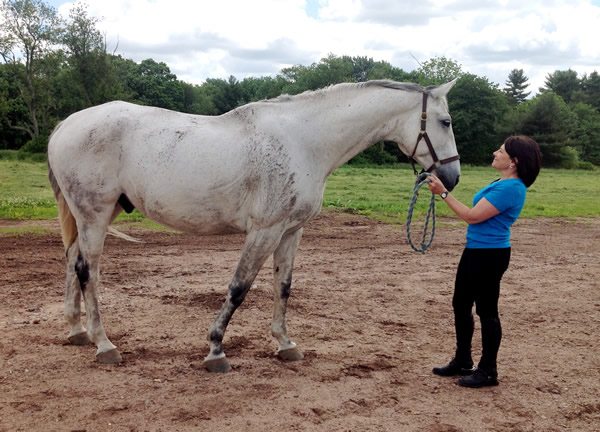
Cheryl Dauphin with Leo, the Horse Behind EquiGroomer
Leo's sensitive skin was the reason EquiGroomer exists. Cheryl Dauphin built the first version of the tool specifically for him.
A Company Built Around One Horse
EquiGroomer started the way many exceptional products start: out of necessity, with no plan to turn it into a business. Cheryl had spent 25 years as a freelance graphic designer before retiring and buying a horse. That horse, Leo, had sensitive skin and reacted negatively to every shedding blade and comb she tried on him. The teeth dug in, the tines pulled, and he hated being groomed. Grooming is supposed to be one of the more pleasant parts of horse ownership, so a change needed to happen.
Cheryl found a workaround in an old farrier trick: a worn-out hacksaw blade with tape wrapped around the ends, dragged over a horse’s coat to pull out dead hair without ever touching skin. It worked. So she refined it, working with a blade manufacturer to develop a tooth pattern that mimicked the texture of a cat’s tongue, gentle enough not to register as anything other than petting, but effective enough to clear out a winter coat in a fraction of the usual time.
What started with one horse didn’t stay small for long. Cheryl began giving handmade tools to friends at her barn, then started showing the product at grooming trade shows, where professional groomers who tried it began recommending it to their own clients. Word spread from horse owners to their friends who owned dogs and cats, and the customer base grew well past anything Cheryl had originally planned for.
Eventually, international orders started arriving from distributors who had seen the tool promoted online and reached out on their own. EquiGroomer was no longer a side project being assembled in a garage. It was a real production operation, and the supply chain behind it needed to grow.
Outgrowing the First Supplier
Cheryl turned to a local custom wood shop that specialized in furniture and one-of-a-kind builds, hoping they could reproduce her handle design at scale.
For a while, it worked. But EquiGroomer kept growing, and the volume eventually outpaced what that shop was set up to handle. They were a custom furniture maker, not a production supplier, and they told Cheryl that they could no longer keep up. She needed something they couldn’t offer: a supplier who could not only produce handles in real volume, but prime and finish them too, a job Cheryl had been doing by hand herself for years, late at night, with cans of spray paint from the hardware store.
That search led her to H.A. Stiles, and specifically to a conversation with Shepard, who has supplied the handles ever since.
“I had to find a company that could not only produce my current and future needs, but was willing to prime them as well,” Cheryl said. “After talking to Shepard and realizing his depth of knowledge and understanding of what I needed to grow my business, I was confident H.A. Stiles could help me move forward.”
The first order came in through a phone call in early January 2020, followed by a formal request for samples built from Cheryl’s own drawing. It was a small, specific ask from a small, specific company. What it became over the next several years was something neither side fully anticipated at the time.
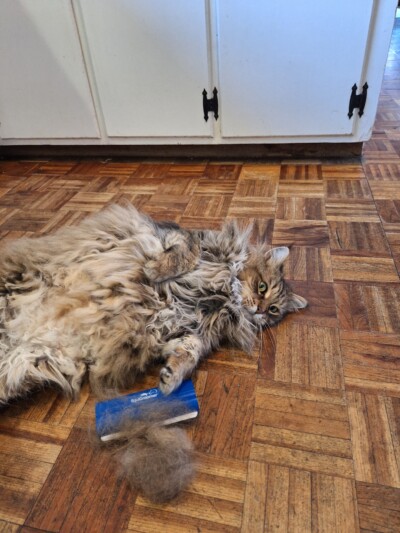
EquiGroomer in Use on a Long-Haired Cat
A long-haired cat relaxed on a wood floor next to the EquiGroomer deshedding tool and a visible pile of loose fur removed during a grooming session.
The Cedar Problem
When Cheryl arrived at H.A. Stiles with her handle design, her first instinct was to use cedar, which made sense on paper. Cedar’s resistance to mold and mildew made it appealing for a tool used in barns and on multiple animals.
The problem showed up in production almost immediately. Cedar is soft and brittle in a way that can split easily in assembly with a grain that raises from atmospheric moisture alone. It doesn’t tolerate high-volume turning and shaping well. Nearly every handle needed resanding to prevent splinters, sometimes more than once.
Shepard had floated mahogany as an alternative early on, but Cheryl resisted at first. The math on cedar kept getting worse, not better, and eventually she agreed to make the switch.
“When I finally got fed up with dealing with the cedar, I agreed to switch,” Cheryl said. “The mahogany looked so beautiful that I kick myself for not listening to Shepard’s advice early on.”
From the H.A. Stiles side, the case for mahogany was straightforward. “The cedar was too soft and dented easily. The mahogany had some weight and a better appearance, and machined very well.” It held up to production, finished beautifully, and solved the splinter problem that had been quietly eating into EquiGroomer’s margins for years.
“The mahogany looked so beautiful that I kick myself for not listening to Shepard’s advice early on.”
Getting the Feel Right
Wood species was only one piece of it. The shape and dimensions of the handle itself changed too, driven less by anything H.A. Stiles suggested and more by what Cheryl was hearing directly from the people using the product.
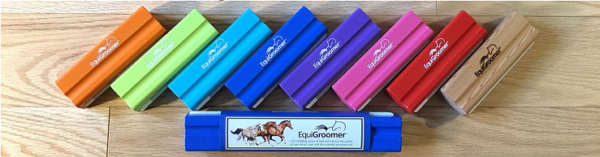
Years of trade shows, before EquiGroomer ever worked with H.A. Stiles, had already taught Cheryl that real-world feedback beats guesswork. Customers told her the original handle had sharp edges that dug into their palms during extended use, and that the overall length made it less comfortable to grip than it needed to be. Stiles took that feedback and rounded the edges over, shortened the handle, and produced samples for Cheryl to evaluate before settling on the current design. Ergonomic handle design is the kind of detail that separates a supplier who fills an order from a supplier who’s paying attention to the product they’re helping build.
As Cheryl expanded EquiGroomer’s color offerings over the years, Shepard helped source other wood species better suited to paint finishing and more cost-effective at volume. This was another quiet adjustment that kept the product both affordable and consistent.
Taking the Burden Off Her Hands
Long before the handle shape or the wood species changed, the most immediate problem H.A. Stiles solved was a simpler problem: Cheryl was burning herself out finishing every handle by hand.
“She was finishing herself by hand and exhausted doing so,” Shepard said. “I offered to finish for her, and we have not changed that process nor the finish itself, except to add colors along the way.”
That handoff did more than free up Cheryl’s time. It also raised the quality bar. EquiGroomer holds its handles to a strict standard: no flaws in the paint, no knots, no tear-out, and no fringe. Every handle gets inspected against that standard. In the early years of the partnership, Shepard and Cheryl worked through more quality issues than either side wanted, with Shepard refinishing pieces that didn’t meet the bar. Over time, that need dropped off almost entirely as H.A. Stiles learned exactly what EquiGroomer needed and built it into their process from the start.
“They’ve been a great partner and have really improved the quality of our products,” Cheryl said. “Not only did they take away the burden of spray painting each handle myself, but we went to a high-quality finish that’s nicer than any of my competitors.”
“They’ve been a great partner and have really improved the quality of our products.”
What a Real Supplier Relationship Looks Like
Ask Shepard what separates H.A. Stiles from a generic wood supplier, and the answer isn’t really about wood at all.
“We have helped numerous customers get started. We have experience and capabilities beyond wood, such as finishing, assembly, and customization, and in Cheryl’s case, determination to see a good idea succeed. Patience is key in the development phase, offering advice and running the smaller quantity orders to help them get started, and we are able to ramp up quickly when things begin to grow rapidly.”
H.A. Stiles took on a small order from a one-woman company working out of her garage, stuck with her through a wood species that wasn’t working, helped fix it, and scaled production right alongside EquiGroomer’s growth in the years that followed.
Where the Relationship Stands Today
Over the years of working together, through the cedar problem, the handle redesign, and the steady climb in volume, the relationship between EquiGroomer and H.A. Stiles has grown even closer. The company remains EquiGroomer’s handle supplier today, and as EquiGroomer looks at expanding its product line in the years ahead, that conversation includes the same company that helped solve many of the problems EquiGroomer faced back when the company was still finding its footing.
This is not a story that shows up on a product label. But it’s the reason the handle in your hand holds up the way it does, rounded instead of sharp, and finished to a standard that took years of back-and-forth to get right.
What This Means If You’re Sourcing Wood Components
EquiGroomer’s experience is not unusual. Most companies that come to H.A. Stiles arrive the same way Cheryl did: with a product that’s outgrown whatever supplier or process got them started, and a list of problems they haven’t fully solved yet.
If you’re working through a component that isn’t holding up, a finish that’s costing you too much time, or a process you’ve outgrown, request a quote and start the conversation.