
Finishing a basement changes the design role of a staircase. What was purely functional before suddenly becomes a visible architectural feature in a finished, occupied space.
For one Connecticut homeowner, this exposed a problem: the original 2×4 at the base of the stairs that was never meant to be seen was now the first thing anyone noticed walking into the newly renovated space. This post did its job. It just didn’t fit a finished home. H.A. Stiles supplied two custom turned newel posts to replace it, designed from scratch to match the architectural design of an existing staircase elsewhere in the house.
Below is a closer look at how this project came together.
The Brief
The homeowner did not have a catalog item in mind when they reached out to H.A. Stiles. There was no off-the-shelf post that matched what was already in the house, and nothing standard would have looked right. The project required a turned post built to a specific profile, sized appropriately for the staircase, and finished to accept paint.
Project specs:
Poplar is a standard choice of wood species for interior paint-grade newel posts. It machines well, holds paint, and is cost-effective compared to harder species when the grain will not be visible in the final finish.
How the Design Came Together
This project started with a photo, a sketch, and a design provided by the customer.
The homeowner referenced an existing turned newel post from a different staircase inside the same house. That reference photo and the other provided materials established the profile of the new posts. From there, H.A. Stiles reviewed the homeowner’s request and worked them into an actionable plan.
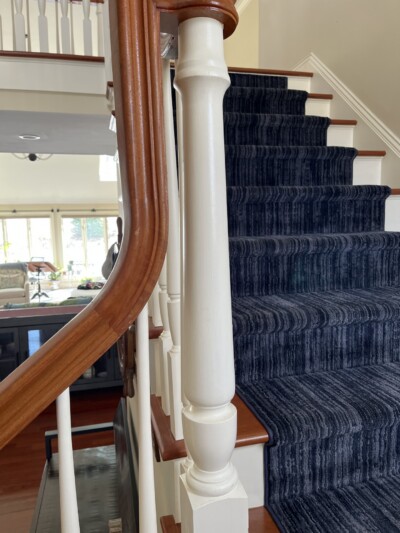
Reference Staircase Newel Post Design
The existing newel post from a different staircase in the same home. This profile served as the design reference for the basement posts.
This process matters because it is how most custom newel projects work. Homeowners will rarely arrive with every technical piece of what they need. They bring a visual reference, a sense of what the space requires, and a result they are trying to achieve. Starting here is enough to move forward.
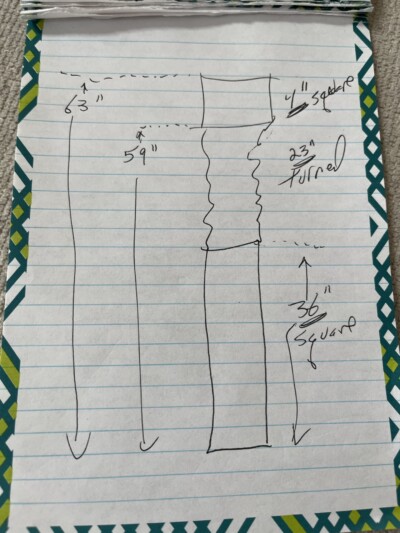
Customer Sketch for Custom Newel Post Design
The customer's initial sketch, with dimensions noted for the square base, turned section, and overall length.
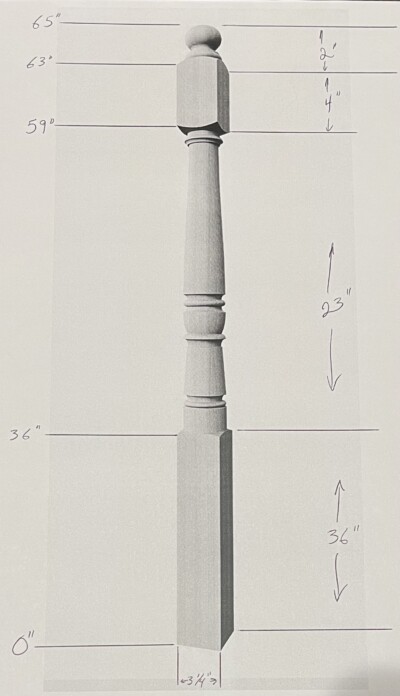
Custom Newel Post Turning Design Drawing with Dimensions
The updated turning design, produced after the customer revised the initial sketch. All dimensions confirmed before production.
The Finished Posts
The two turned poplar posts were sanded and shipped to Connecticut for installation. The ball top detail carries through the profile without competing with the rest of the staircase, which was the intent from the start. The goal was always integration, not a statement on its own.
The posts replaced the exposed structural 2×4 and gave the finished basement staircase a consistent identity with the rest of the home. No off-the-shelf product would have accomplished this with the same effect.
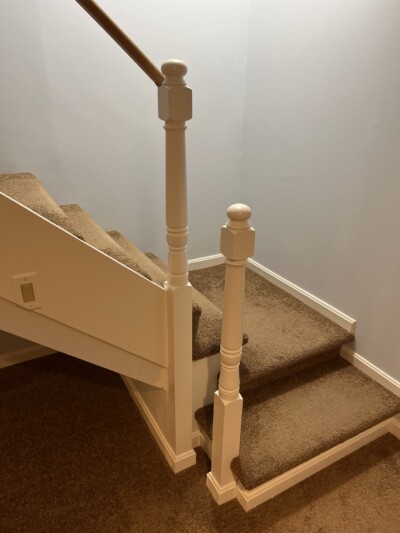
Custom Newel Posts Installed on Basement Stairs
The installed pair on the finished basement staircase. The turned profile and ball top replaced an exposed structural 2x4 that had no place in a finished space.
What the Customer Had to Say
Byron and Janis Day shared their experience after the project was complete. Their Google review is worth reading in full, but the short version: the posts delivered on what was discussed, the process was straightforward, and the result matched the vision.
This kind of outcome is determined before the order is placed. It starts with a clear understanding of what the project needs and a process for obtaining the correct design specs before production begins.
Starting a Custom Newel Post Project
Most people who reach out about a custom newel post are in a similar position: they know what they are trying to achieve and they have a reference or a rough idea. However, they’re not sure whether what they need is even possible to order. It is.
The starting point is simpler than most people expect. A photo of an existing post to match, a rough sketch of a profile, a description of the space and the application, the species or finish requirement if known, and the quantity needed. H.A. Stiles can work from any of those.
Custom newel posts can be ordered alongside wood balusters and other stair and railing components. Reproductions of an existing post, replacements for a damaged or missing piece, and new designs built from a reference or a sketch are all possible.
Send a reference photo or describe the project to request a quote with no obligation.