
Your Balusters Are Discontinued. Now What?
You managed to track down the style. You found the wood baluster profile that matches the rest of your staircase, or at least something close enough to work. Then you hit a wall.
Discontinued. No longer available. Out of stock with no restock date.
The manufacturer stopped making them, the supplier dropped the line, or the home improvement store simply doesn’t carry anything that comes close. And if your home is older, the problem is deeper. The style you’re looking for may never have been in a modern catalog to begin with since it was made for your house at the time.
If you’ve been renovating an older home, you’ve probably been here before with other details and aspects of the project. But balusters are different. They’re not a finishing detail you can quietly swap out. They run the entire length of your staircase. If you choose the wrong profile, the whole thing looks like a patchwork fix rather than a serious renovation.
But discontinued doesn’t mean gone forever. It just means the mass market stopped producing it, or never produced it at all. Custom wood suppliers such as H.A. Stiles never stopped.
Today, we’ll explain what discontinued means for your project, what options you have, and exactly what information you need to get matching replacement balusters made to spec, even if the original manufacturer stopped producing them decades ago or the profile was built for a house that’s over a century old.
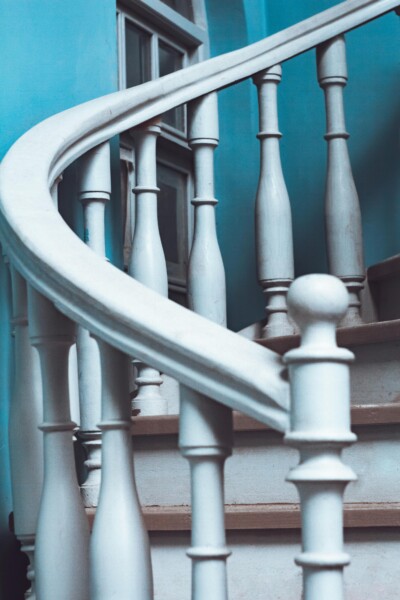
Turned Wood Balusters on a Curved Staircase
Turned wood balusters like these are among the most commonly discontinued profiles, and among the most replicable when you work with the right supplier.
Why Balusters Become Discontinued
Mass market manufacturers make decisions based on volume. When a baluster profile stops selling well enough to justify keeping it stocked, it gets cut from the catalog. This has nothing to do with whether the profile is beautiful or historically significant. It just wasn’t moving off shelves fast enough.
This creates a real problem for homeowners with older staircases. The balusters in a Victorian home or a mid-century colonial were often produced by companies that no longer exist, using profiles that were standard at the time but have since vanished from retail availability. The big box stores carry a narrow range of contemporary profiles. If your home was built before 1980 and hasn’t been fully renovated, there’s a reasonable chance that what you really need for your project isn’t sitting in any aisle anywhere.
The same problem shows up in newer homes. Builders sometimes spec balusters from suppliers who later discontinue the line or go out of business. A home built in the early 2000s can have just as hard a time finding replacement balusters as a house built in 1910.
This means that the retail path is often a dead end before you even start. The good news is that this path is not the only one.
When the Style Was Never in a Modern Catalog
Some homes present a different version of this problem. If your house was built before 1940, there’s a good chance your balusters were never produced by a modern manufacturer. They were made by a local millwork shop, a regional lumber company, or a craftsman whose business closed long ago. There’s no discontinued listing to find because they were never listed anywhere.
This is common in Victorian, Federal, Greek Revival, and early Craftsman homes, as well as in any older home that hasn’t been fully renovated. The balusters were made to suit the house at the time it was built, often following period conventions rather than standardized profiles. That makes them harder to find through retail channels but not harder to replicate through custom production.
A supplier working from a physical sample or detailed photographs with some basic measurements doesn’t need a catalog entry. They need enough information to understand the profile, and older turned styles are often straightforward to work from because the design conventions of those periods are well understood.
What Custom Turning Solves
When a profile is discontinued, it doesn’t mean no one can make it. Custom wood turning is exactly what it sounds like: a wood component produced to a specific profile, diameter, length, and species.
For baluster replacement, this matters. A custom wood supplier doesn’t need to stock your profile. Rather, they need to understand it well enough to replicate it. That’s a completely different kind of problem, and it’s one that skilled suppliers such as H.A. Stiles have been solving for a long time.
The profiles used in older American homes, including colonial turned styles, Victorian spindle shapes, and Craftsman square-and-taper combinations, are not mysteries. They follow established design conventions that experienced wood turners recognize immediately. Even unusual or heavily ornamented profiles can usually be replicated from good photographs or physical samples.
What You Need to Get a Match Made
This is where most people get stuck, which is usually because they assume they need more than they have available. You do not need the original manufacturer’s name, a product number, a catalog page, or any documentation from the original purchase. What you need is enough information about the baluster itself to allow a supplier to replicate it accurately. Here is what that means.
A physical sample or clear photographs. If you have even one intact baluster you can remove temporarily, that’s your best starting point. A physical sample tells a supplier almost everything they need to know. If you can’t remove one, close-up photographs from multiple angles, including straight-on from the side and from the top and bottom, give a good working picture of the profile. The more detail you capture in the photos, the better. Natural lighting and a plain background make the profile much easier to read.
Measurements. You need two core dimensions: the overall length and the diameter at the widest turned section. If the top or bottom is square, use the thickness of that section instead. If you can also measure the spacing and placement of the decorative turned sections along the length, that helps a supplier understand the proportions of the profile. A basic tape measure gets you most of the way there.
The wood species, if you know it. This one is helpful but not essential. Many older staircases used oak, poplar, or maple, which remain widely available. If you’re not sure what species your existing balusters are, a supplier can often make a reasonable recommendation based on the grain, finish, and color in your photos. If you want an exact match for an unfinished or lightly finished staircase, identifying the species matters more.
Quantity. Know how many you need before you reach out. Replacement projects range from a few damaged pieces to a full staircase run. Custom suppliers work across that entire range, but having a number ready speeds up the quoting process and helps a supplier give you an accurate lead time.
The Matching Process, Explained Simply
Once you have the relevant information together and you’ve reached out to a supplier, here’s what the process typically looks like.
The supplier reviews your photos or sample alongside your measurements. If anything is unclear, they’ll ask follow-up questions. From there, a quote is generated based on the profile complexity, species, quantity, and any finishing requirements you have. Pricing varies based on all of those factors, but the quote process itself doesn’t require a commitment.
Once the quote is approved, the balusters are turned to spec. For straightforward profiles, this is a relatively efficient process. For more complex Victorian or heavily ornamented profiles, there may be a longer production window. Finished balusters are then shipped directly to you or your contractor for installation. At that point, the replacement process looks exactly like any other baluster installation.
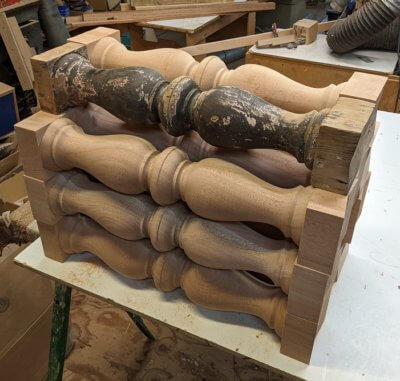
Custom Paint-Grade Mahogany Balusters with V-Cut Bottoms
These V-cut balusters were custom-matched in paint-grade mahogany for a customer order.
What to Do If You’re Not Sure the Profile Can Be Matched
Some homeowners hesitate to reach out because they’re worried their profile is too unusual, too old, or too worn to replicate. This is understandable, but it stops people from finding answers they could have had in a single conversation.
The threshold for “this can be matched” is lower than most people assume. Suppliers who specialize in custom wood components have seen an enormous range of profiles over the years. Historic reproductions, unusual regional styles, heavily weathered samples, and partial balusters with missing sections have all been used as the basis for successful replication projects. If you have something to work from, it’s worth asking.
If your balusters are so damaged that even a partial sample isn’t usable, photographs of intact balusters elsewhere on the same staircase combined with your measurements will likely do the job.
The worst outcome of reaching out is that you’re told you need something more specific. That’s still useful, and it points you toward exactly what to gather next. The worst outcome of not reaching out is staying stuck on a renovation that has a solution you never found.
When to Consider Replacing the Full Run Instead of Matching
Most of the time, matching is the right approach. It preserves the design of the staircase and keeps the project cost proportional to the actual damage.
However, if your existing balusters are a poor stylistic fit for the home to begin with, a renovation is a reasonable opportunity to correct that. Knowing when to consider the alternative saves you from spending money on a partial fix when a more complete solution serves the project better.
The Bottom Line
Discontinued doesn’t mean unresolvable. A style that predates modern manufacturing doesn’t either. Whether your profile was cut from a catalog last year or was last produced by a millwork shop that closed before your grandparents were born, the path forward is the same. You can work from samples, photographs, and measurements to produce balusters that match existing staircases with accuracy.
If you’re looking at a staircase that needs matching replacement balusters and you’re not sure where to start, the right move is to reach out with what you have.
You don’t need to have all the answers before you ask the question. Reach out to us today.